

How to Find Bike Frame Size: A Complete Guide
Table of Contents
- How to Find Bike Frame Size: Understanding the Basics
- How to Measure a Bike Frame with a Tape Measure
- Using a Bike Frame Size Chart to Match Your Measurements
- Determining Bike Size by Height and Inseam
- Sizing Formulas and Frame Geometry Considerations
- Fit Checks After Finding Your Frame Size
- Common Mistakes When Measuring Bike Frame Size
- Frequently Asked Questions
Last Updated: October 5, 2026
How to Find Bike Frame Size: Understanding the Basics
Finding the right bike frame size is one of the most important decisions you'll make as a cyclist. Get it wrong and you'll be uncomfortable, less efficient, and at higher risk of injury. Get it right and you unlock better handling, faster power transfer, and a bike that feels like an extension of your body.
The process isn't complicated, but it requires precision. Most people guess based on height alone or measure without understanding what they're measuring. Both approaches fail.
Here's what actually works: combine frame measurements with your body dimensions, then verify with a test ride or fit check. We'll walk you through exactly how to do it.
How to Measure a Bike Frame with a Tape Measure
The most direct way to find a bike frame size is to measure the frame itself. This works whether you're buying used, checking an unlabeled frame, or verifying that a frame matches its advertised size.
You'll need a tape measure (metal is more accurate than fabric) and about two minutes. The key is knowing where to measure.
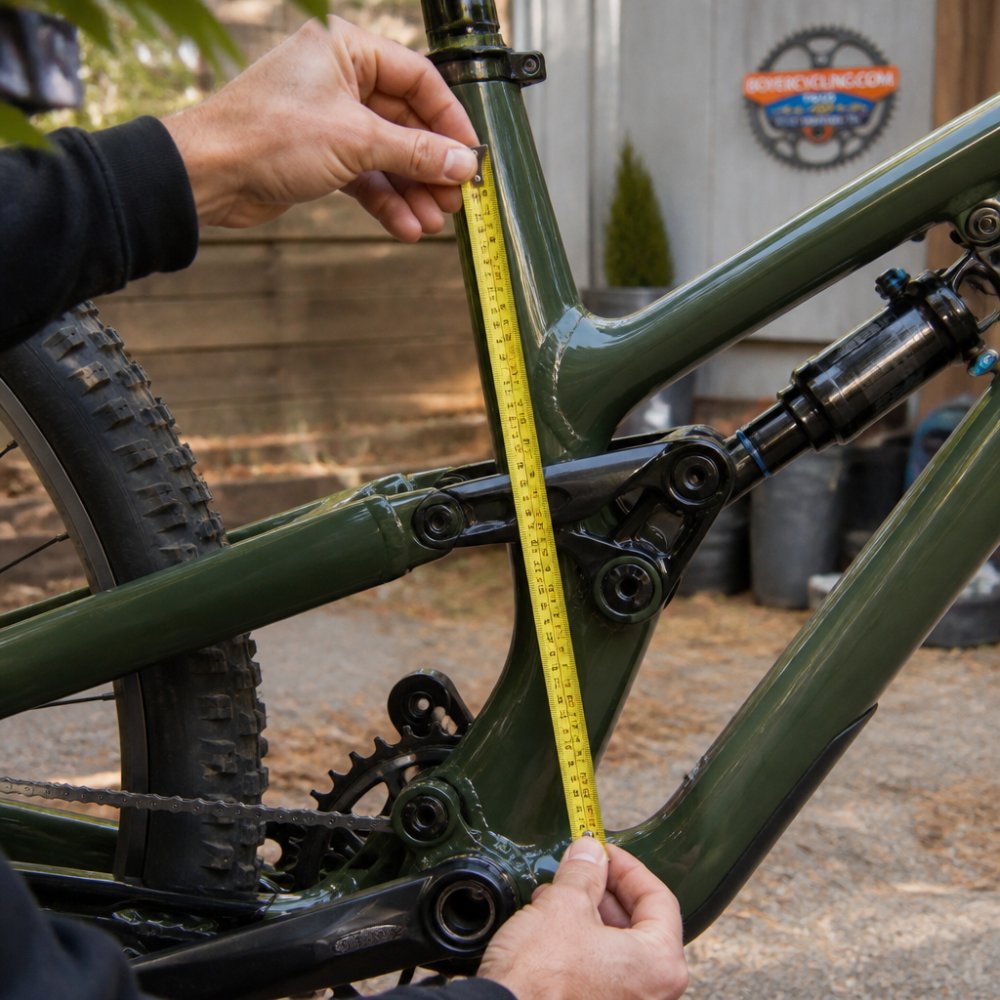
Measuring Seat Tube Length
The seat tube is the vertical tube that runs from the bottom bracket (where the pedals attach) up to where the seatpost slides in. This is your primary measurement.
Here's the process:
- Place the bike upright on flat ground
- Locate the center of the bottom bracket (the round part where the crank arms connect)
- Measure straight up along the seat tube to where it meets the top tube
- Record the measurement in centimeters or inches
This single measurement is often all you need. Most manufacturers list frame size by seat tube length. A 56cm frame means a 56-centimeter seat tube.
Center-to-Center vs. Center-to-Top Measurements
Here's where most people make mistakes.
Center-to-center measures from the center of the bottom bracket to the center of the top tube. Center-to-top measures from the center of the bottom bracket to the top edge of the seat tube.
Different manufacturers use different standards: center-to-center, center-to-top, or center-to-bottom (measuring to where the seat tube ends).
This matters because it changes the number you get. The same frame might be labeled 56cm center-to-top but 54cm center-to-center, so know which standard your frame uses.
Check the manufacturer's website or size chart. If the label says "56cm," look up that specific model to confirm the measurement method used.
Measuring When the Size Label Is Missing
Sometimes the label is worn off, illegible, or was never there. You can still figure out the frame size.
Measure the seat tube from center bottom bracket to top of seat tube for a baseline. Then:
- Compare against known size charts for that frame model (search the manufacturer's site)
- If you know the bike's year and model, the manufacturer's archive often lists frame geometry
- Contact the original bike shop, which may have records
- Post a photo on cycling forums with your measurement; experienced riders can usually identify a frame
Once you have the seat tube length, match it to a size chart. A 52cm seat tube is typically small, 56cm medium, and 58-60cm large, but these ranges vary by brand.
Using a Bike Frame Size Chart to Match Your Measurements
After measuring the frame, compare it to a size chart to see whether the frame size matches your body.
Most manufacturers publish size charts that cross-reference frame size with rider height and inseam length, based on years of fit data.
Here's how to use one:
- Find the manufacturer's official size chart (usually on their website under "sizing" or "geometry")
- Locate your height range in the left column
- Look across to find your inseam measurement
- The corresponding frame size is your target
The chart might show multiple sizes that could work when you're between sizes. In that case, you have a choice:
- Choose smaller if you prefer responsive handling and a more aggressive riding position. You'll be more stretched out. This suits road racing and aggressive trail riding.
- Choose larger if you prefer a more upright position and comfort over responsiveness. You'll be more compact. This suits casual riding and long-distance touring.
Determining Bike Size by Height and Inseam
If you don't have a frame to measure yet, estimate the right size using your body dimensions to narrow down options when shopping for a new bike.
Your height and inseam matter most. Height tells you the general ballpark; inseam tells you the specific fit.
Measuring Your Inseam and Inside Leg Length
Your inseam (also called inside leg length) is the distance from your crotch to the floor. It directly determines your saddle height and, indirectly, your frame size.
To measure inseam:
- Stand barefoot against a wall with your heels touching the wall
- Place a book or level horizontally between your legs, pulled up snug (like you're sitting on a bike seat)
- Mark where the top of the book meets the wall
- Measure from the floor to that mark
Record this in centimeters. A typical adult inseam ranges from 70cm to 90cm+.
Now cross-reference your height and inseam against the manufacturer's size chart. Most charts show a range:
- 5'0" to 5'3" (inseam 70-75cm): Small frame (48-52cm)
- 5'4" to 5'7" (inseam 76-80cm): Medium frame (52-56cm)
- 5'8" to 5'11" (inseam 81-85cm): Large frame (56-60cm)
- 6'0" and up (inseam 86cm+): X-Large frame (60-64cm)
These are approximations; your actual best size depends on your proportions and riding style.
Road Bike vs. Mountain Bike Sizing Differences
Road bikes and mountain bikes size differently, even for the same rider.
Mondraker - RAZE R Bike - Red/Grey (TRAIL) →
Road bikes use more aggressive geometry: a longer top tube and center-to-top seat tube measurement.
Mountain bikes use slacker geometry (more upright, less stretched out), and the seat tube measurement often includes the sloping top tube.
Don't assume your road bike size is your mountain bike size. Always check the specific manufacturer's chart for the bike type you're buying.
For example, the Mondraker RAZE R comes in sizes S (380mm), M (420mm), L (470mm), and XL (510mm). These are mountain bike sizes.

Sizing Formulas and Frame Geometry Considerations
Some riders use formulas to estimate frame size. They aren't perfect, but they give you a ballpark.
The most common formula is:
Inseam (cm) × 0.67 = seat tube length (cm)
So if your inseam is 80cm, you'd calculate: 80 × 0.67 = 53.6cm seat tube.
This formula works reasonably well for road bikes but is less reliable for mountain bikes, whose geometry varies more widely.
Beyond seat tube length, frame geometry uses other measurements to describe fit:
- Reach: horizontal distance from the bottom bracket to the head tube. Longer reach means you stretch more.
- Stack: vertical distance from the bottom bracket to the head tube. Higher stack means more upright position.
- Top tube length: effective top tube (accounting for sloped tubes). Longer tubes = more stretched position.
If you're upgrading, comparing these numbers to your current bike shows how the fit will change: longer reach and lower stack feel more aggressive, while shorter reach and higher stack feel more upright.
Fit Checks After Finding Your Frame Size
Once you've identified the right frame size, verify the fit before you commit.
The best test is a 15-30 minute ride on terrain similar to what you'll actually ride. Pay attention to:
- Saddle height: when pedaling, your leg should be nearly straight at the bottom of the pedal stroke (about 25-30 degrees of knee bend). If your knee is too bent or too straight, the frame size might be wrong.
- Reach to the handlebars: you should reach the handlebars without overextending your arms or hunching your shoulders, with a slight bend in your elbows.
- Standover height: standing over the frame with feet flat, there should be 1-2 inches of clearance between your crotch and the top tube (2-3 inches for mountain bikes).
- Overall comfort: does the bike feel natural or does something feel off? Trust your gut.
You can adjust saddle height or swap stem length, but if the frame itself feels fundamentally wrong, you probably chose the wrong size.
Common Mistakes When Measuring Bike Frame Size
Most measurement errors come from these habits:
Measuring the wrong tube. Some riders measure the down tube (the diagonal tube from the head tube to the bottom bracket) instead of the seat tube. The down tube is longer and gives a false reading. Always measure the vertical seat tube.
Not accounting for sloped top tubes. Modern mountain bikes often have sloped top tubes.
Comparing frames across different brands. A 56cm frame from one manufacturer isn't identical to a 56cm frame from another.
Choosing based on height alone. Your inseam matters more than your height.
Finding the right bike frame size takes a few minutes but saves months of discomfort and inefficiency.
At BoyerCycling, we stock premium bikes like the Mondraker RAZE R and Mondraker DUSK series in multiple frame sizes.

| Measurement Type | What It Tells You | How to Use It |
|---|---|---|
| Seat tube length | Frame size in cm | Primary sizing metric |
| Inseam | Your leg length | Cross-reference with height for size chart |
| Reach | How stretched the position is | Compare between frames for fit feel |
| Stack | How upright the position is | Compare between frames for comfort level |
| Standover height | Clearance over top tube | Safety check for mountain bikes |
International Cycling Union frame geometry standards define how professional bikes are measured, providing a baseline for industry consistency.
Trek's bike sizing guide offers detailed geometry charts and measurement instructions that apply broadly across frame types, even if you're buying a different brand.
SRAM drivetrain compatibility guide helps you verify that components you buy will work with your frame's bottom bracket and drivetrain setup, preventing costly compatibility mistakes after you've sized your frame.
Frequently Asked Questions
Where is the frame size written on a bike?
The frame size is typically printed on a sticker or label located on the seat tube, usually a few inches above the bottom bracket. The label shows the size in centimeters (for most brands) or inches. If the sticker is worn or missing, you can measure the seat tube directly from the center of the bottom bracket to the top of the seat tube to determine the frame size.
How do I measure a bike frame size if I don't have the original label?
Use a tape measure to find the seat tube length by measuring from the center of the bottom bracket (where the cranks attach) to the top of the seat tube. Measure in centimeters for accuracy. Compare your measurement to manufacturer sizing charts for your bike type. Road bikes, mountain bikes, and other styles use different conventions, so identify your bike type first before consulting the appropriate size chart.
What size bike should I get for my height?
Bike size depends on your height and inseam length. Most manufacturers provide sizing charts that cross-reference rider height with recommended frame sizes. As a general starting point, measure your inseam (inside leg length from crotch to floor in bare feet), then use that measurement with a sizing formula specific to your bike type. Mountain bikes typically run smaller than road bikes for the same rider, so always consult the specific manufacturer's chart for your intended bike style.
Do road bikes and mountain bikes size differently?
Yes, road bikes and mountain bikes use different sizing conventions. Mountain bike frames tend to run smaller relative to rider height, offering more standover clearance for safety on technical terrain. Road bikes typically run larger for a more aggressive riding position. Always check the manufacturer's sizing chart for your specific bike type rather than assuming sizing translates directly between disciplines.